


What The Candle Keeps
Cynthia was five feet four and built like a line drawing that had decided to be alive, lean through the waist, long in the limbs, with a dark mane of hair that fell past her shoulders and a face that painters would have called expressive, which is just a polite word for restless. She was twenty-two and stunning. She painted for a living and lived for the painting, and on this particular morning she sat astride an old push bike in the pale gold of early summer, pedaling down a lane where the hedges ran silver with heat, and she felt the whole world lean toward her like a window left open.
A friend had suggested it over coffee, casual as a passing cloud: There's that old house on the Harrow farm. Abandoned for decades. Go paint it. The light in there must be extraordinary. And because Cynthia trusted color more than she trusted advice, and because a decaying farmhouse at the end of a forgotten lane was exactly the kind of place her brush wanted to argue with, she had said yes before the coffee cooled.
So here she was now, the bike leaning against a fence post furred with lichen, the canvas already unrolled on its easel in the broken front porch, the tubes of paint lined up like soldiers, cadmium, raw umber, a viridian that looked almost black. The house stood behind her and breathed. That was the only word for it. The clapboard walls sweated damp into the air; the floorboards under the porch groaned when she shifted her weight, as if remembering footsteps they had not heard in a very long time. Cynthia made her preliminary sketches with quick, confident strokes, the tilt of the gable, the way the porch sagged on one side like a tired shoulder, and then she began to paint, and for a while there was nothing in the universe but the slow marriage of pigment to canvas.
She did not notice the sky change until the light changed. The sun, which had been a warm coin above the tree line, slid behind a wall of grey that rolled up out of the west with the patience of something that had been waiting all day for her. The air turned cold and tasted of iron. A first fat drop struck her cheek. Then another. Then the sky simply opened.
Cynthia ran.
She made it through the front door as the rain came down in sheets, a curtain of sound so total it swallowed the world outside. She stood dripping on the bare floor, gasping, and looked at herself, her dress dark and heavy with water, her hair plastered to her neck, and decided, with the practicality of a woman who had once finished a commission in a downpour, that she would not stand there shivering. She stripped off the wet clothes and draped them over the backs of two old chairs by the wall to dry. Naked to the cold air, barefoot on the planks, she felt the house close around her like a fist, and she told herself it was only the draft, only the storm, only the way an empty building amplifies every small sound until it sounds like a voice.
The storm lasted a very long time.
She lost count of it. She paced from room to room with her paintbrush still in her hand, sketching by the grey light that seeped through the broken windows, the kitchen with its dead stove, the hallway where the wallpaper had peeled into long pale tongues, a bedroom whose bed frame had rusted into a brown skeleton. She searched it all, turning corners, counting doors, and as she counted the geometry of the place began to feel wrong, the way a word on the tip of your tongue feels wrong when you cannot say it. A corridor that should have ended at the back wall seemed to go on. A door she had passed an hour ago, two hours? stood in a place where no door had been before. She could not find her way out.And so, with the brush still loose in her fingers and the cold settling into her bones, Cynthia walked toward that door at the end of the long hall, the one that should not have been there, the one whose paint was the color of dried blood.
She paused at it. Through the gap beneath the frame she could see the yard, and she stopped breathing for a moment, because it was dark. Not the blue-black of dusk, not the soft dim of a storm-clouded evening, dark, the flat and absolute dark of a sky with no sun in it at all.
Strange, she thought. Surely it must be light by now. She had been in here so long; the storm must have broken; the sun must have come back up over those trees. She told herself she had simply misjudged the hours, that her wits were addled with cold and wet and the strange tiredness that lived in this house like a tenant. She told herself all of it, because the alternative was a shape she could not yet hold, and so she set her hand on the door and pushed.
It did not open. Or rather, it opened onto more hallway. And then more. And then a room she had not seen before, with a row of candles burning on the floor.
Cynthia stood very still among them. There were perhaps a dozen, set in a loose line down the center of the boards, their flames steady and golden in a house that had no windows left to admit wind. They did not gutter. They did not flicker. One near her foot had burned almost to its stub, yet as she watched it lengthened, wax climbing back up toward the wick as if time there ran on a different clock than the one on her wrist. She wanted to ask a question of them and could not find the words. She wanted to call out into the dark that this was a mistake, that she was only an artist, that she had come here to make something beautiful and not to be kept. But no sound came. The house held its breath with her.
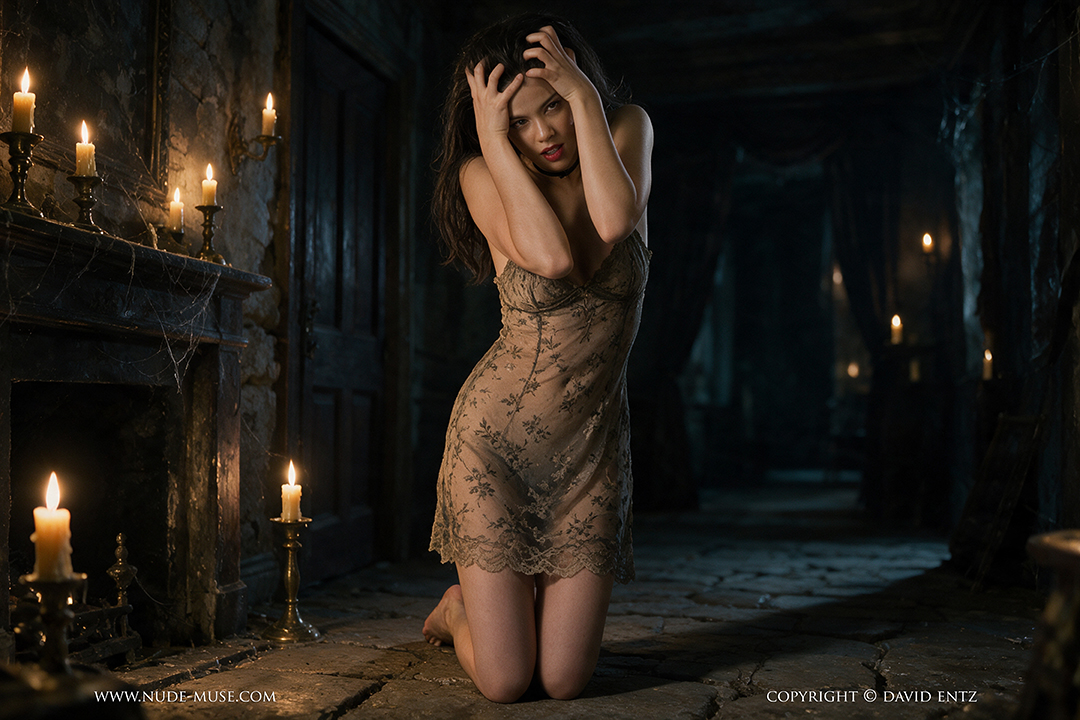
She did not know how long she stood there, minutes, hours, a season, a century, for the candles kept their patient light and the dark beyond the door kept its patience too, and Cynthia moved through it all as one moves through deep water, aware of distance but unable to measure it. She was still naked; she had not put her dress back on, or perhaps she had and forgotten, or perhaps in this place a woman did not need them. Her hair hung dark over her face. She was barefoot, and the floor was cold under her feet, and she was afraid, though she could not yet name what she was afraid of, only that the fear had weight and texture and the smell of old woodsmoke.
Then she heard them.
Footsteps on the porch. The creak of the front door. Voices, four of them, young, carrying with them the bright and careless noise of the living, which struck her like a physical blow because it was so normal, so impossibly ordinary after the long silence. Two voices were high and tight with fear; two were low and loose with the easy cruelty of boys who have never been truly afraid and are now discovering that they can be. Beams of light, torches, flashlights, swept the dark in slow white arcs, raking the peeling walls, the rusted bed, the line of candles on the floor.
Cynthia was naked, and she was alone in a house that had no business holding her, and every animal instinct she possessed said hide. She ducked behind the leg of an old table near the candle-line, pressing herself into the shadow at its base, and watched them move through their light.
She could not make out what they were saying. The words came to her muffled, as if through water, or as if she were standing very far away from her own ears. A girl whispered something that sounded like please. A boy laughed it off. Another girl said, in a voice that cracked on the last syllable, I don't want to be in here much longer. The boys teased her for it, and the teasing made her fear worse, because they were so sure of themselves, so certain that this was a game with rules she already knew how to play.
One of the boys stopped. His torch beam slid across the table leg, across the shadow beneath it, and held.
"Over there," he said. "I think I saw something."
He pointed in Cynthia's direction.
Panic, clean and white-hot, snapped through her chest. She scrambled to duck away, to slip behind the next wall, to put a little more distance between herself and that beam of light, and in her rush her elbow caught an old lamp standing on a low shelf, and it toppled, and its single flame spilled out across the floorboards like a small broken star, and the sudden flare of it lit up the table leg, lit up the shadow, lit up her.
They came at once. All four of them, torches converging, and the light found her on the floor among the candles, naked, barefoot, dark-haired, her face a mask of confusion and embarrassment because she was naked and they were staring and there was no explanation for it that did not sound like madness. The two girls screamed. It was a clean, bright, human scream, the kind a person makes when the world they understood has just shown them a seam in itself.
The first boy, the one who had pointed, stepped forward into the candlelight and looked at her with an expression that was half awe and half the particular delight of a skeptic whose skepticism has just been executed.
"See?" he said, grinning now, because to grin was easier than not to. "I told you this place was haunted."
Cynthia looked up at him. She was so confused she could barely think in straight lines, and beneath the confusion was a deep and bewildered embarrassment, you are looking at me as if I am a thing, but I am a person, I paint, I ride my bike down silver hedges, I have a life, and so she did the only reasonable thing left to her. She asked, in a voice that came out smaller than she wanted it to:
"What do you mean?"
The boy's grin widened, but his eyes did not. "You're a ghost," he said, as if naming a weather condition. Then, because he was twenty and could not resist a flourish: "And the hottest one I've ever seen." He nodded at her with something like genuine admiration. "You've been haunting this house for over fifty years. That's the story they tell down in town, you went out here to paint it, and you never came back."
Fifty years.
The number landed in Cynthia's mind not as a fact but as a door, and the door opened onto a room she had spent five decades refusing to look into, and now the candles all burned at once, very bright, and the dark behind her eyes went away.
She remembered that day. Not the storm, she had forgotten the storm, or perhaps there never had been a storm, only the light, the gold of it on the porch, the smell of turpentine, the slow pleasure of color finding its place. She remembered that she had not been alone. There was a man in the house with her. He had come to meet her; he had promised to bring the big canvas, the one too wide for her to carry down the lane, and he had stood behind her while she painted, close enough that she could smell his soap, close enough that his shadow fell across her work. She remembered turning to say something to him, look how the light is coming through that window now, look what it's doing to the wood, and remembering, in the same breath, the hands.
Not hands that helped. Hands that closed. Around her throat. From behind. While she was looking at the light and not at him. She remembered the panic of it, the furious, animal panic, the way her own scream had been strangled in her before it could become a sound, the way the world had narrowed to the pressure on her windpipe and the cold floor against her cheek and the face above her, his face, the face she had trusted, the face that now, after fifty years of not looking, finally came into focus. Peter. Her friend, the one who suggested this place. The man who had come to keep her company and found, in the quiet of an empty house, a reason to make sure no one ever kept her.
She remembered the fury too. Not the fear, the fury. Because that was the part she had locked away, the part that would not let her rest. The injustice of it. The way he had stood over her body afterward and looked at what he had done with the same casual satisfaction he used to look at everything else, as if a girl were just another thing in the house to be arranged or discarded.
Fifty years of that fury, banked and burning under the silence of the candles, and now it was here, now it was now, and Cynthia did not hold it back.
She screamed.
It was not a sound a throat was made to make. It came up out of her like water out of a broken well, fifty years of grief and rage and the raw, howling unfair of it all, poured through one open mouth in a single banshee note that did not travel so much as arrive, that filled the room and the hallway and the porch and the yard and the lane and the silver hedges and the whole grey sky at once. The candles flared to the ceiling. The walls shuddered. The air turned to something you could stand in only if you were made of the same stuff as the house, because it was old, it was heavy, it was the accumulated weight of every night she had stood in this dark and screamed into a silence that never answered back.
The four teenagers stood in the middle of it. The two girls did not even get to scream again; their mouths opened and stayed open, and their eyes went wide and fixed, and they simply stopped, as if someone had reached into their chests and switched off a light. The boys lasted a moment longer, the one who had pointed went pale and tried to run for the door and found his legs would not carry him, and the other stood with his torch still raised and a smile frozen on his face that was no longer a grin but a rictus of pure, animal terror. One by one the beams in their hands guttered and died, and they went down among the candles like four more flames added to the line, and the house breathed over them, and kept them.
And then it was quiet again. The same patient, breathing quiet. The same row of light on the floorboards. The same dark beyond the door that had no sun in it.
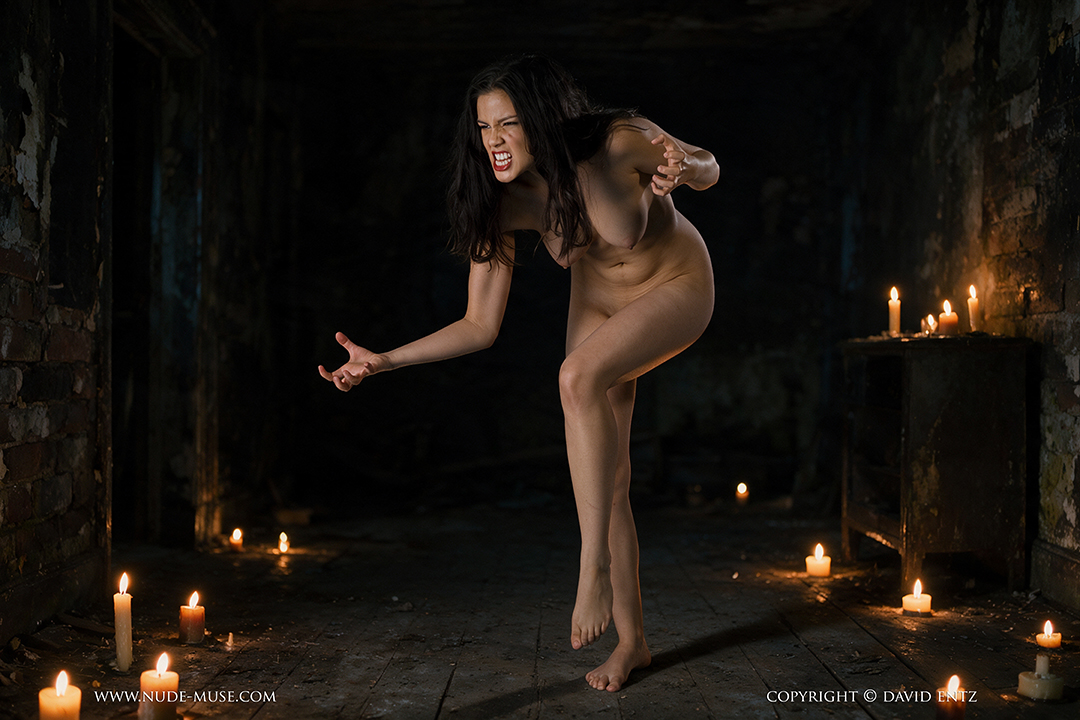
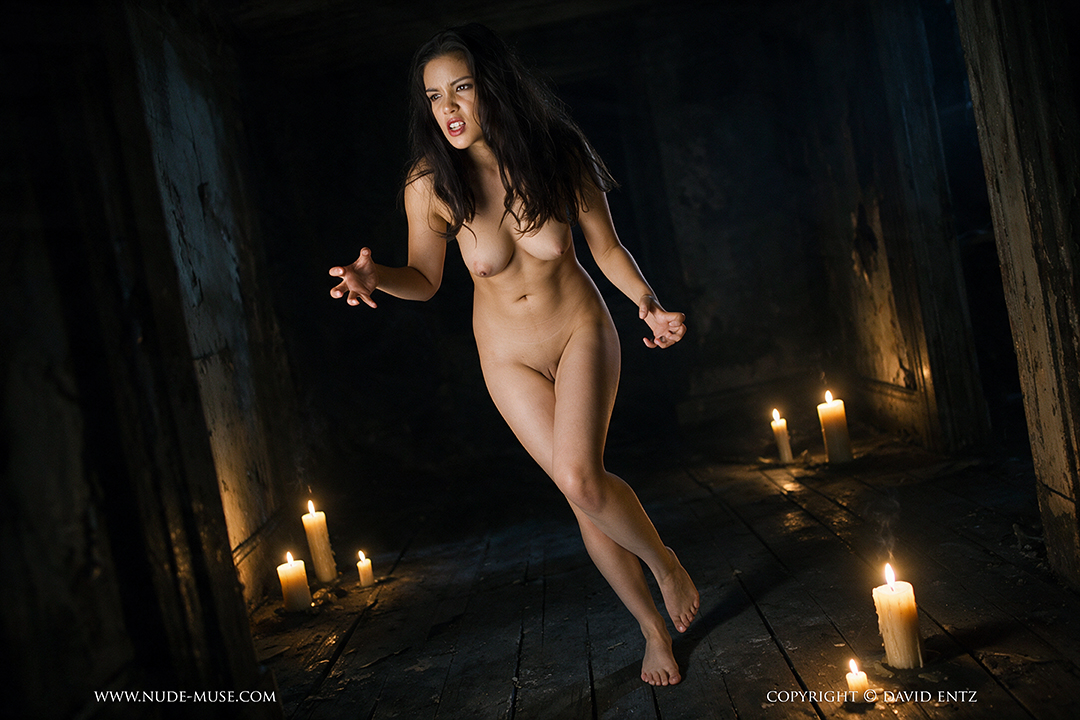
Cynthia stood up slowly from where she had fallen. Her hair hung dark over her face; she was barefoot and naked and five feet four and lean as a line drawing, and she moved down the center of the hall among the candles exactly as the picture of her would one day be painted by someone who did not know her name, mid-stride, hands open, mouth still shaped around the last of the scream, an expression caught between alarm and fury, lit from below by a dozen small fires in a room that had no windows. She was not alone anymore. Behind her, at the edge of the light, four new shapes stood in the dark where she had once stood, two girls with their mouths still open, two boys with their torches cold, and they did not need to speak, because she already knew what it was to be a thing the house kept, and now there were five of them, and the line on the floor would grow, candle by candle, year by year, until the whole old farm was full of light that no one could blow out.
The storm had long since passed. The sun had set and risen and set again so many times it had worn a groove in the sky. And Cynthia walked on down the hall, barefoot, among the flames, into the dark that would never lift, painting with her memory the only picture she had left to finish, the one where at last, after fifty years, someone was standing there to look.
This is purely a fictitious story and is not a reflection on the real Cynthia in any way.
Yes Cynthia does have a model profile page, which you can find HERE.
Join now to see more artistic nude photos